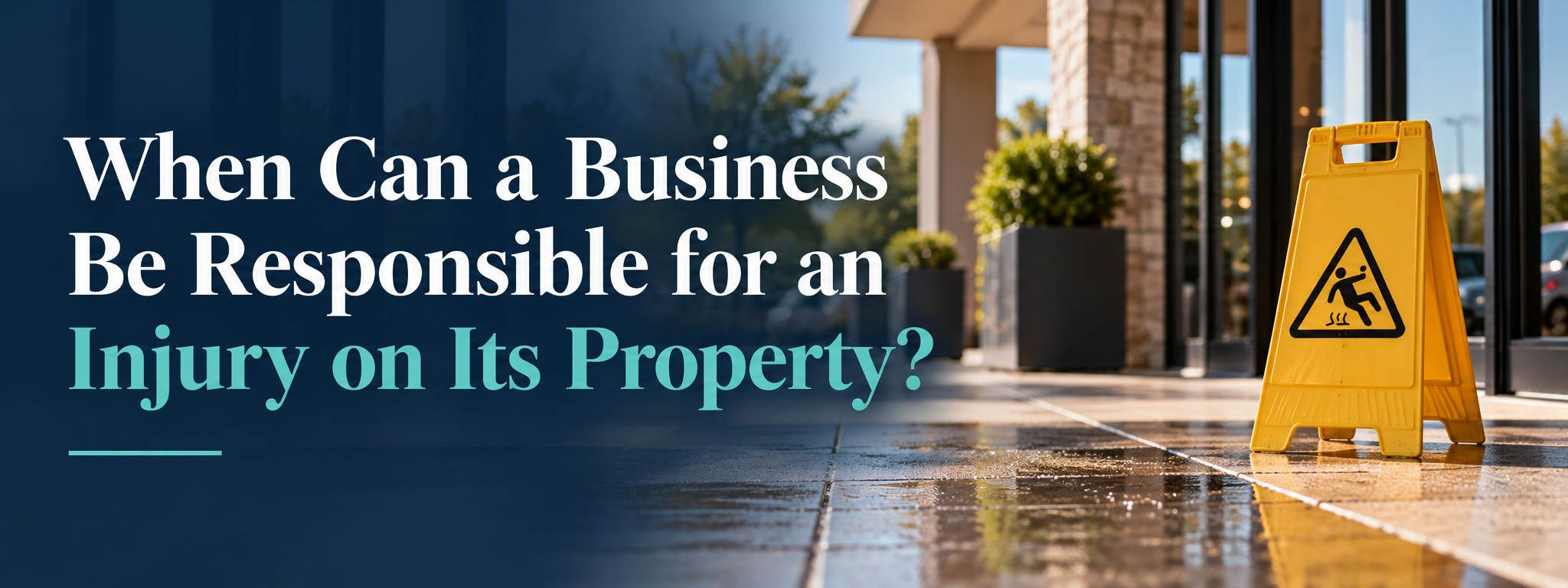
A fall in a grocery store. A broken step outside a restaurant. Poor lighting in a parking lot. Merchandise or debris blocking a walkway.
When someone is injured at a business, one of the first questions is often:
Is the business responsible because the injury happened on its property?
Not necessarily.
The fact that an injury occurred at a store, restaurant, hotel, apartment complex, parking lot, or another business property does not automatically mean the owner or business is legally responsible.
Premises liability cases can be very fact-specific. At Reid Law Group, evaluating one of these matters means looking closely at what caused the injury, who controlled the property, what the business knew or reasonably should have known about the condition, what the injured person knew, and what evidence exists to show what happened.
Understanding those facts can be an important first step in determining whether a premises liability claim may exist.
What Is Premises Liability?
Premises liability generally refers to injuries caused by unsafe conditions or activities on property owned, occupied, managed, or controlled by another person or business.
Depending on the circumstances, these cases can involve conditions such as:
- Wet or slippery floors
- Spills
- Broken or uneven flooring
- Potholes
- Damaged stairs
- Missing or defective handrails
- Poor lighting
- Debris or merchandise in walkways
- Falling objects
- Unsafe parking lots
- Defective entrances or exits
- Certain security-related conditions
But every accident on someone else’s property is not automatically a premises liability case.
At Reid Law Group, we look beyond the fact that an injury occurred and focus on why it happened and what the evidence shows about the condition that caused it.
Who Owned or Controlled the Area Where the Injury Happened?
One of the first questions Reid Law Group may examine is who was actually responsible for the area where the injury occurred.
That is not always as simple as looking at the name on the building.
A property may involve:
- The property owner
- The business operating at the location
- A landlord
- A tenant
- A property management company
- A maintenance company
- A cleaning company
- A security company
- A contractor or vendor
Depending on the circumstances, different people or companies may have different responsibilities for inspecting, maintaining, repairing, cleaning, or securing the property.
For example, a business may lease its storefront while a property management company is responsible for the parking lot or common areas. In another situation, a third-party cleaning company may have been responsible for maintaining the floor where someone fell.
At Reid Law Group, part of investigating a premises liability matter may involve identifying who had control over the specific area and what responsibilities each person or company had.
Why Was the Injured Person on the Property?
The reason someone was on the property may also matter.
A customer shopping in a store, a restaurant patron, a hotel guest, a delivery driver, an event attendee, and someone entering without permission may not necessarily be treated the same under the law.
In many premises liability matters, the relationship between the property owner or business and the injured person is part of the analysis.
At Reid Law Group, we consider why the person was on the property, whether they were invited or expected to be there, and what duties may have existed under the circumstances.
What Exactly Caused the Injury?
A premises liability investigation should be specific.
It is not enough to say:
“I fell in a store.”
The more important question is:
“What caused the fall?”
Depending on the circumstances, that could be:
- Water or another liquid
- Grease
- Food
- Ice
- Torn carpet
- Loose flooring
- Uneven pavement
- A broken step
- A missing handrail
- Poor lighting
- Merchandise or equipment in a walkway
- Construction debris
- A recently mopped surface
At Reid Law Group, identifying the exact condition that caused the injury helps us understand what questions need to be investigated next.
Did the Business Know About the Dangerous Condition?
This is often one of the most important questions in a premises liability matter.
A business may have actually known about a dangerous condition. For example, an employee may have seen a spill, received a complaint about a broken step, or already attempted to address a problem.
In other situations, the question may be whether the condition existed long enough, or under circumstances where the business reasonably should have discovered it.
Depending on the facts, Reid Law Group may look for evidence showing:
- Whether an employee created the condition
- Whether employees saw the condition
- Whether customers previously reported it
- Whether similar incidents had occurred before
- Whether inspection records documented the issue
- Whether repair requests had been made
- How long the condition may have existed
The business’s knowledge and the timing of that knowledge can be central issues.
How Long Had the Hazard Been There?
Timing can make a major difference.
Consider two situations:
In the first, a customer spills a drink and someone slips almost immediately.
In the second, a spill remains on the floor for an extended period while employees repeatedly pass through the area.
Those situations may raise very different questions.
Reid Law Group may investigate how long the condition existed and whether the business had a reasonable opportunity to discover and address it.
Evidence that may help answer those questions can include:
- Surveillance footage
- Witness statements
- Employee testimony
- Cleaning records
- Inspection logs
- Incident reports
- Photos
- Time-stamped records
This is also one reason early investigation can matter.
Did the Business Have Inspection and Maintenance Procedures?
Businesses often have procedures for inspecting and maintaining their property.
But having a written policy is not always the same as following it.
When Reid Law Group evaluates a premises liability matter, we may look at questions such as:
- Were employees expected to inspect the area?
- How often were inspections supposed to occur?
- Were those inspections actually completed?
- Was the area cleaned regularly?
- Had repairs been requested?
- Were repairs delayed?
- Were known hazards documented?
- Were warning signs used?
- Was maintenance handled by another company?
- Were the business’s own safety procedures followed?
One important question may be whether the business’s actual practices matched the procedures it said employees were supposed to follow.
Were There Warnings?
Warnings may also matter.
A business may use:
- Wet floor signs
- Cones
- Barricades
- Warning tape
- Posted notices
- Employee warnings
- Temporary closures
But the existence of a warning does not necessarily answer every question.
At Reid Law Group, we may consider:
- Where the warning was placed
- Whether it was visible
- When it was placed
- Whether it adequately identified the danger
- Whether someone could reasonably avoid the condition
- Whether the warning was present before or after the incident
The entire context matters.
What Did the Injured Person Know About the Condition?
Premises liability cases can also involve questions about what the injured person knew or could reasonably see.
Depending on the circumstances, Reid Law Group may look at:
- Whether the condition was visible
- Whether the person had seen it before
- Whether the lighting made it difficult to see
- Whether something blocked the person’s view
- Whether the person was directed through the area
- Whether the condition was hidden or unexpected
- Whether there was a reasonable opportunity to avoid it
These questions are not about automatically blaming the injured person.
They are part of evaluating the complete circumstances of the incident.
At Reid Law Group, we look at what both the business and the injured person knew about the condition and what the available evidence shows.
Did the Condition Actually Cause the Injury?
A dangerous condition may exist, but there still needs to be a connection between that condition and the injury.
For example, if someone falls near a spill, evidence may still be needed to establish whether the spill actually caused the fall.
Depending on the case, Reid Law Group may review:
- Medical records
- Medical bills
- Photos
- Surveillance video
- Witness statements
- Incident reports
- Emergency medical records
- Follow-up treatment
- Prior medical history
The goal is to understand how the condition, the incident, and the injuries relate to one another.
What Evidence Can Matter After an Injury on Business Property?
Evidence is often especially important in premises liability cases because property conditions can change quickly.
A spill may be cleaned.
A broken step may be repaired.
Merchandise may be moved.
Surveillance footage may eventually be overwritten.
Employees may change positions or leave the company.
That is why Reid Law Group may look for evidence such as:
- Photos of the condition
- Video from the scene
- Surveillance footage
- Witness names and statements
- Incident reports
- Employee records
- Inspection logs
- Cleaning records
- Maintenance records
- Repair requests
- Prior complaints
- Prior incidents
- Business safety policies
- Medical records
- Medical bills
Depending on the circumstances, even clothing, footwear, receipts, or other items from the incident may become relevant.
What About Inadequate Security or Criminal Activity?
Premises liability does not always involve a spill, broken stair, or physical defect.
Some cases may involve injuries connected to security conditions on a property.
Depending on the circumstances, those cases can raise questions involving:
- Lighting
- Security personnel
- Access controls
- Parking lot conditions
- Prior criminal activity
- Security policies
- Whether similar incidents had occurred before
These matters can involve different legal and factual issues from a traditional slip-and-fall case.
If someone is injured because of an assault or other security-related incident on business property, Reid Law Group may evaluate the circumstances surrounding the property, security measures, prior incidents, and other available evidence.
What If the Business Says It Did Not Know About the Hazard?
That is a common issue in premises liability matters.
A business may argue that:
- The condition had only existed briefly
- Employees had already inspected the area
- No one had reported the hazard
- The condition was obvious
- The injured person should have avoided it
- The business did not create the condition
Those assertions do not necessarily end the inquiry.
At Reid Law Group, we look at the evidence.
That may include surveillance footage, employee statements, inspection records, maintenance documents, witness testimony, prior complaints, and other information that helps establish what happened before the injury.
The investigation should focus on the facts, not simply assumptions made immediately after the incident.
What Should You Do After Being Injured at a Business?
Every situation is different, and safety and medical needs come first.
When possible, some steps may help preserve important information after an injury:
- Seek appropriate medical attention.
- Report the incident to the business.
- Ask that the incident be documented.
- Photograph or record the condition if it is safe to do so.
- Identify witnesses.
- Keep receipts, clothing, footwear, and other potentially relevant items.
- Save medical records, bills, insurance information, and correspondence.
- Keep copies of anything the business provides after the incident.
If you are unsure what information may matter, Reid Law Group can review the circumstances and help identify the issues that may need further investigation.
Why Premises Liability Cases Can Become Complicated
A premises liability case may involve questions about:
- Property ownership
- Property control
- The injured person’s reason for being there
- The dangerous condition
- What the business knew
- How long the condition existed
- Inspection procedures
- Maintenance
- Warnings
- What the injured person knew
- Causation
- Medical treatment
- Insurance coverage
- Evidence preservation
That is why the question is rarely just:
“Did someone get hurt at a business?”
At Reid Law Group, we often need to ask:
Why did the injury happen? Who controlled the property? What was known about the condition? How long had it existed? Was there an opportunity to correct or warn about it? And what evidence exists now?
Those questions can help determine whether a premises liability claim may be appropriate.
How Reid Law Group Evaluates Premises Liability Matters
At Reid Law Group, we do not treat premises liability matters as generic “slip-and-fall” cases.
Every property, business, hazard, and injury has its own facts.
Depending on the circumstances, our team may review:
- Property ownership and management information
- Incident reports
- Surveillance footage
- Witness information
- Inspection records
- Cleaning records
- Maintenance records
- Repair requests
- Business safety procedures
- Prior complaints or incidents
- Medical records and bills
- Insurance information
- Other evidence related to the property and the injury
Our goal is to understand what happened, who may have had responsibility for the property or condition, and what legal options may be available.
Injured on Someone Else’s Property? Reid Law Group Can Help You Understand What Comes Next.
A business is not automatically responsible simply because someone is injured on its property.
But when an unsafe condition contributes to an injury, important questions may need to be answered about who controlled the property, what the business knew or should have known, whether reasonable inspections occurred, whether warnings were provided, what the injured person knew, and whether the condition caused the injury.
If you were injured at a store, restaurant, hotel, apartment complex, parking lot, or another property in Georgia, Reid Law Group can review the circumstances with you and help you understand what questions may need to be investigated.
Call Reid Law Group at (678) 342-9333 or visit reidlawgroup.net to discuss your circumstances.